
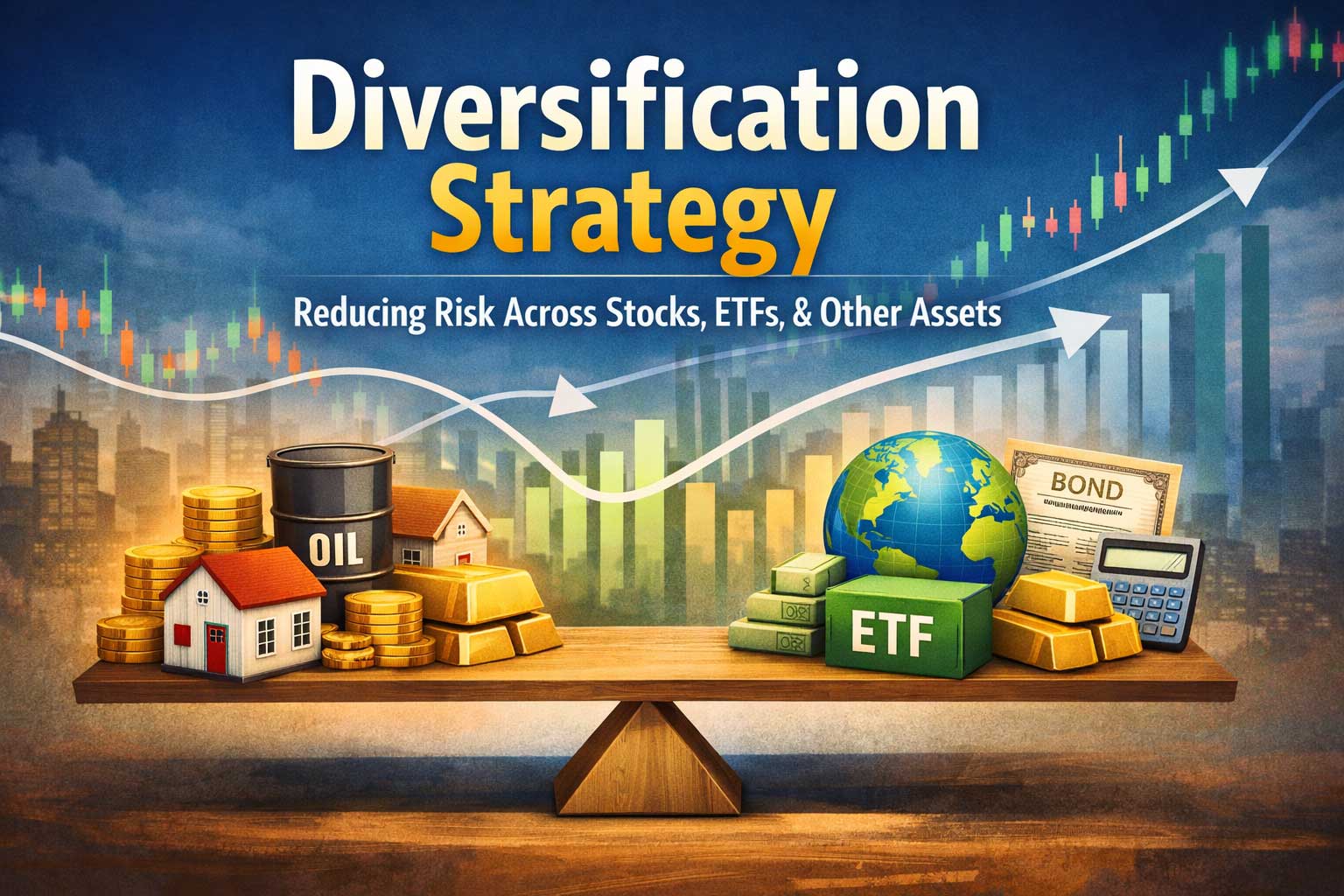
Diversification is one of the few investing ideas that stays useful in almost every market environment. It’s simple to say—“don’t put all your eggs in one basket”—but building a truly diversified portfolio is more detailed than buying a handful of different tickers and hoping for the best.
A good diversification strategy is not about owning “a lot of stuff.” It’s about combining assets that behave differently so your overall portfolio becomes more stable, more predictable, and easier to stick with over time. Done well, diversification can reduce the impact of any single company, sector, country, or economic shock on your money. Done poorly, it can create a false sense of safety while you’re unknowingly concentrated in the same risk over and over again.
This guide walks you through a complete, practical diversification strategy across stocks, ETFs, and other assets. You’ll learn what diversification can and cannot do, how to diversify in multiple dimensions (not just “number of holdings”), how to use ETFs intelligently, how to avoid hidden overlap, and how to build and maintain a portfolio that matches your goals and risk tolerance.
What Diversification Really Does (and What It Doesn’t)
Before you decide what to buy, you need to understand what problem diversification is trying to solve.
Diversification reduces “specific risk,” not all risk
There are two broad categories of risk in investing:
- Specific risk (idiosyncratic risk): Risk tied to a single company or a small group of companies. Examples include a product failure, fraud, a lawsuit, a key executive leaving, or one business model becoming outdated.
- Market risk (systematic risk): Risk that affects most investments at the same time. Examples include recessions, interest-rate shocks, financial crises, wars, and major shifts in inflation or economic growth.
Diversification is extremely good at reducing specific risk. If one stock collapses, the rest of a diversified portfolio can keep your plan intact.
Diversification is less effective at eliminating market risk. When markets crash broadly, many assets fall together. Diversification doesn’t prevent declines; it aims to reduce the depth and damage of declines and improve your ability to stay invested.
Diversification works through correlation, not variety
People often confuse “owning different things” with diversification. But the real engine behind diversification is low correlation—assets that do not move in the same direction at the same time and with the same intensity.
If you own ten tech stocks, you own ten names—but you may still be making one big bet on the tech sector. The variety is cosmetic; the underlying risk is concentrated.
A diversified portfolio combines assets that respond differently to:
- Economic growth (booms vs recessions)
- Interest rate changes (rising vs falling)
- Inflation surprises (high vs low inflation)
- Risk appetite (panic vs optimism)
- Currency movements (domestic vs foreign exposure)
Diversification is also a behavioral tool
A portfolio that is slightly “less optimal” on paper but easier to hold in real life often produces better results than a portfolio that looks perfect in theory but causes panic in practice.
Your biggest enemy is not usually a lack of clever assets. It’s:
- Selling after big drops
- Chasing what just went up
- Abandoning a plan during uncertainty
Diversification’s hidden superpower is that it can smooth the ride enough that you actually stick to your strategy.
The Many Dimensions of Diversification
A strong diversification strategy is built across multiple dimensions. Think of diversification like a net: the more angles it covers, the less likely a single shock can punch a hole through your plan.
1) Diversification by asset class
Asset classes are broad categories of investments that tend to behave differently. Common examples:
- Stocks (equities): Growth-oriented, volatile, long-term return potential
- Bonds (fixed income): Income-oriented, typically less volatile, sensitive to interest rates
- Cash and cash equivalents: Stability, liquidity, low return potential
- Real estate (often via REITs): Income + inflation sensitivity, unique cycles
- Commodities: Inflation sensitivity, highly cyclical and volatile
- Inflation-protected bonds: Designed to respond to inflation changes
- Alternatives (limited/complex): Can diversify but often add complexity and cost
2) Diversification within stocks
Even if you only invested in stocks, you can still diversify by:
- Sector and industry (tech, healthcare, financials, consumer staples, energy, etc.)
- Company size (large-cap, mid-cap, small-cap)
- Geography (domestic vs international vs emerging markets)
- Style and factors (value vs growth, profitability, quality, momentum, low volatility)
- Revenue exposure (companies earning money globally vs locally)
3) Diversification within bonds
Bonds also need diversification. You can diversify by:
- Duration (interest-rate sensitivity): short-term vs intermediate vs long-term
- Credit quality: government vs investment-grade vs high-yield
- Issuer type: government, municipal, corporate
- Inflation protection: nominal bonds vs inflation-linked bonds
4) Diversification by time and process
How and when you invest matters:
- Dollar-cost averaging spreads entry risk over time
- Rebalancing forces you to buy low and sell high mechanically
- Emergency cash reserves reduce the chance you sell investments at the worst time
Diversification is not only what you hold—it’s also how you manage it.
Diversifying Across Stocks: Building a Strong Equity Core
Stocks are often the main engine of long-term growth, but they can also be the biggest source of portfolio stress. Good stock diversification focuses on reducing concentration while maintaining exposure to long-term growth.
Why single-stock risk is bigger than most people think
A single stock can go to zero. Even strong companies can suffer long periods of underperformance. A portfolio built from a small number of individual stocks can be dominated by a few outcomes—good or bad.
If you like picking stocks, you can still diversify, but you need guardrails.
Practical guardrails for stock picking
- Limit single-stock position size: Many disciplined investors cap one stock at 3%–5% of a portfolio.
- Limit sector concentration: A common limit might be 20%–30% per sector for stock-heavy portfolios (your limit depends on goals and risk tolerance).
- Own enough names: The point is not a magic number, but if you only hold 5–10 stocks, one bad event can do real damage.
- Avoid “look-alike” companies: Ten companies that all depend on the same trend are not diversified.
Diversify across sectors (not just tickers)
Sectors respond differently to the economy:
- Technology: Often benefits from growth and falling rates, can suffer when rates rise or valuations compress
- Consumer staples: More defensive; people buy essentials even in downturns
- Healthcare: Often defensive with unique drivers
- Financials: Sensitive to interest rates and credit cycles
- Energy and materials: Sensitive to commodity cycles and inflation
- Industrials: Sensitive to economic activity and spending cycles
- Utilities: Often defensive but interest-rate sensitive
A portfolio overexposed to one sector can feel diversified until that sector hits a rough patch.
Diversify by company size (large, mid, small)
- Large-cap stocks can be more stable and globally diversified through their revenues.
- Small-cap stocks can offer higher growth potential but tend to be more volatile and economically sensitive.
- Mid-cap stocks can sit between the two.
Size diversification helps because different company sizes often lead in different market phases.
Diversify by geography (international exposure)
Many investors have “home bias,” meaning they invest mostly in their home country because it feels familiar. But economic fortunes change. Currency cycles change. Political and regulatory environments change. A globally diversified stock portfolio can reduce the risk of any one country underperforming for a long time.
International exposure can also diversify:
- Sector makeup (some markets have more financials, industrials, or commodities than others)
- Currency exposure (which can help or hurt depending on cycles)
- Valuation cycles (some markets can be cheaper or more expensive at different times)
Diversify by style and factor exposure
A common hidden concentration is “everything I own is basically the same style.”
- Growth stocks often do well when rates are low and optimism is high.
- Value stocks often do better when inflation is higher, rates rise, or markets rotate.
- Quality/profitability factors can provide resilience.
- Momentum can boost returns but can reverse sharply.
- Low-volatility strategies aim to reduce drawdowns but can lag in roaring bull markets.
You don’t need to obsess over factors, but you do want to avoid a portfolio that is unintentionally “all one factor.”
How ETFs Fit Into a Diversification Strategy
ETFs are one of the most practical tools for diversification because they can hold dozens, hundreds, or even thousands of securities in one product. But ETFs can also create hidden concentration if you don’t understand what’s inside them.
Why ETFs are powerful diversification tools
ETFs can help you:
- Gain instant broad market exposure
- Reduce single-company risk
- Access international markets easily
- Build bond exposure with different durations and credit qualities
- Target specific themes or factors (carefully)
- Rebalance efficiently
The core ETF categories
A well-built ETF-based portfolio often uses these building blocks:
1) Broad equity ETFs (core holdings)
These cover:
- Total market (large + mid + small)
- Large-cap indexes
- Global developed markets
- Emerging markets
Core equity ETFs are often the foundation because they reduce single-stock risk automatically.
2) Sector ETFs (use sparingly)
Sector ETFs (tech, healthcare, etc.) can help fine-tune exposure, but they also increase concentration. They work best as small “satellite” positions around a diversified core.
3) Factor/style ETFs (use intentionally)
Value, quality, dividend, low volatility, and momentum ETFs can diversify the way you’re exposed to stocks. The key is to avoid stacking multiple factor ETFs that end up owning the same stocks.
4) Bond ETFs
Bond ETFs can diversify by:
- Government vs corporate
- Short vs intermediate vs long duration
- Investment-grade vs high-yield
- Inflation-protected bonds
5) Real estate ETFs (often REIT-focused)
These provide real estate exposure through publicly traded real estate companies.
6) Commodity ETFs (high caution)
Commodities can diversify inflation risk, but they can be volatile and complicated depending on how they are structured.
The biggest ETF diversification mistake: hidden overlap
Many investors buy multiple ETFs thinking they’re diversifying, but the underlying holdings can overlap heavily.
Example of overlap risk:
- A “total market” ETF already owns many large tech companies.
- You add a “large-cap growth” ETF that owns many of the same large tech companies.
- You add a “technology sector” ETF that concentrates further in those same names.
You now have a portfolio that looks diversified (three ETFs!) but may be dominated by one segment of the market.
How to spot overlap without complicated tools
You can often detect overlap by checking:
- The top holdings listed for each ETF
- Sector weights (tech-heavy vs balanced)
- Style labels (growth vs value)
- Region exposures (mostly one country vs global)
The goal isn’t to avoid overlap completely; it’s to avoid being unintentionally concentrated.
ETF risks to understand (so you diversify correctly)
Even diversified ETFs have risks:
- Market risk: A broad stock ETF will still fall in a market crash.
- Concentration risk inside an index: Some indexes are heavily weighted toward the largest companies.
- Interest rate risk in bond ETFs: Bond prices fall when rates rise, especially long-duration bonds.
- Liquidity and spreads: Most major ETFs are liquid, but niche ETFs can trade with wider spreads.
- Tracking differences: ETFs aim to track an index, but costs and structure can create small differences.
Diversification means understanding the risks you are taking, not assuming “ETF = safe.”
Diversifying Beyond Stocks: Bonds, Cash, and Stability Assets
If stocks are the growth engine, bonds and cash-like assets often serve as the stability system. They can help reduce volatility, provide liquidity, and give you rebalancing power during downturns.
Bonds: the main stabilizer, but not risk-free
Bonds are loans to governments or companies. They pay interest and return principal at maturity (in many cases). Bonds can reduce portfolio volatility, but they are sensitive to two main forces:
- Interest rates
When rates rise, existing bond prices typically fall (especially longer-term bonds).
When rates fall, existing bond prices typically rise. - Credit risk
Corporate bonds depend on the issuer’s ability to pay. If a company struggles, its bond prices can fall.
Duration: the core bond diversification lever
Duration is a measure of interest-rate sensitivity.
- Short-term bonds: Less sensitive to rate changes, lower yields (generally), more stability
- Intermediate-term bonds: Balanced sensitivity and yield
- Long-term bonds: Higher sensitivity to rate changes, can help during recessions when rates fall, but can get hit hard when rates rise
A diversified bond approach often includes a duration mix rather than only one maturity range.
Credit quality: diversify safety vs yield
- Government bonds: Typically higher safety, lower yields
- Investment-grade corporate bonds: Moderate safety, moderate yields
- High-yield bonds: Higher yields, but behave more like stocks in downturns
A common diversification trap is using high-yield bonds as a “safe” bond allocation. In many market sell-offs, high-yield bonds fall along with stocks because credit risk spikes.
Cash and cash equivalents: the underrated risk manager
Cash has a job:
- Emergency fund and near-term spending
- Stabilizer for peace of mind
- Dry powder for rebalancing in down markets
Cash is not a long-term growth asset, and inflation can erode its purchasing power, but it can reduce the chance you sell investments at the worst time.
A diversification strategy is stronger when you include cash for the right reasons, not as a reaction to fear.
Real Assets: Real Estate, Commodities, and Inflation Protection
Real assets often respond differently than stocks and nominal bonds, especially during inflation shifts.
Real estate exposure (often via REITs)
Real estate can provide:
- Income (through rents)
- Potential inflation sensitivity (rents and property values can rise with inflation over time)
- Diversification versus traditional stocks, though REITs can still be correlated with equities during broad market stress
Public REITs trade like stocks, so they can be volatile. They are not the same as owning a physical rental property, but they are a practical way to add real estate exposure without high capital requirements or illiquidity.
Commodities: useful, but complex and volatile
Commodities (energy, metals, agriculture) can:
- Respond strongly to inflation and supply shocks
- Provide diversification in certain environments
But commodities can be extremely volatile and can underperform for long periods. Commodity exposure through financial products can also behave differently than spot prices due to how contracts are rolled or structured.
For most long-term investors, commodities are better treated as a small satellite allocation rather than a core holding.
Inflation-protected bonds
Inflation-protected bonds are designed to help when inflation surprises to the upside. They can diversify a portfolio that is otherwise heavily exposed to nominal bonds and stocks.
Alternatives: When “More Assets” Becomes “More Complexity”
Alternative assets are often marketed as diversification solutions, but they can introduce new risks: illiquidity, fees, complexity, and opaque performance.
Common alternatives and the diversification reality
- Private equity / private credit: Can diversify publicly traded exposure, but often illiquid and fee-heavy.
- Hedge fund strategies: Some provide diversification, others behave like expensive versions of stocks and bonds.
- Cryptocurrencies: Highly volatile and still evolving; diversification benefits can appear in some periods and disappear in others. Treat as speculative if used at all.
- Collectibles: Highly illiquid and dependent on niche markets.
A good rule: if you don’t understand how it makes money and what drives its losses, it is not “diversifying.” It’s adding unknown risk.
A Step-by-Step Diversification Plan You Can Actually Use
The best diversification strategy is the one you can implement consistently and maintain through market cycles.
Step 1: Define your goal and time horizon
Ask yourself:
- Is this money for retirement decades away, or a goal in 3–5 years?
- Will I need withdrawals soon?
- How stable does my portfolio need to be to avoid panic selling?
Long horizons can tolerate more stock exposure. Short horizons require more stability.
Step 2: Identify your “risk capacity” and “risk tolerance”
- Risk capacity: How much risk you can afford financially (income stability, emergency savings, time horizon).
- Risk tolerance: How much volatility you can emotionally handle without abandoning your plan.
Your portfolio should be built around the lower of the two. If you can afford risk but can’t sleep during volatility, your strategy should prioritize staying power.
Step 3: Choose a simple core allocation framework
A practical approach is a core-satellite structure:
- Core: Broad, diversified ETFs across global stocks and high-quality bonds
- Satellite: Small positions for tilts (small-cap, value, REITs, sector bets, commodities) if you have a reason and discipline
Core is where your plan lives. Satellite is optional.
Step 4: Pick an allocation that matches your goals
Below are three example allocations that sum to 100%. These are educational templates, not personal advice.
Example A: Growth-focused (higher volatility)
- 75% Stocks (domestic + international)
- 20% Bonds (mostly high quality, intermediate duration)
- 5% Real assets or cash buffer
Example B: Balanced (moderate volatility)
- 60% Stocks
- 35% Bonds
- 5% Cash or real assets
Example C: Conservative (lower volatility)
- 40% Stocks
- 55% Bonds
- 5% Cash
Within each, you can diversify further. For example, inside the stock portion you might split:
- Domestic broad market
- International developed
- Emerging markets (smaller portion)
Inside the bond portion you might split:
- Short/intermediate government bonds
- Investment-grade corporates
- Inflation-protected bonds (optional)
Step 5: Diversify your stocks intelligently (avoid accidental concentration)
A simple stock diversification structure might look like:
- Majority in a broad total stock market exposure
- A meaningful portion in international stocks
- Optional small tilts (small-cap or value) if desired
The key is that your diversification should be structural, not accidental.
Step 6: Diversify your bonds with purpose
A practical bond approach often includes:
- A core of high-quality government and investment-grade bonds
- A duration that matches your risk needs
- Optional inflation protection depending on your situation
If your goal for bonds is stability, keep credit risk moderate. If you chase yield too aggressively, your “bond” allocation may behave like a stock allocation when stress hits.
Step 7: Decide your rebalancing method in advance
Rebalancing is where diversification becomes real. Without rebalancing, your winners can dominate your portfolio and quietly increase risk.
Two common methods:
Calendar-based rebalancing
- Rebalance on a schedule (every 6 or 12 months).
Simple and consistent.
Band-based rebalancing
- Rebalance when an allocation drifts beyond a set threshold (for example, 5 percentage points away from target).
This reacts to markets more directly.
Rebalancing is emotionally hard because it often requires selling what feels exciting and buying what feels disappointing. That’s exactly why it works.
How to Tell If Your Portfolio Is Truly Diversified
A portfolio can look diversified and still be fragile. Here are practical ways to measure diversification without needing advanced math.
1) Concentration check
Ask:
- Do my top 10 holdings dominate my portfolio?
- Is one sector or theme much larger than the rest?
- If one big company drops 50%, does it seriously hurt my plan?
Even with ETFs, concentration can be high if the index is dominated by a few mega-cap names.
2) Overlap check
If you own multiple funds:
- Do they share the same top holdings?
- Are they all labeled “growth”?
- Are they all heavy in the same sector?
Overlap is not automatically bad. Hidden overlap is the problem.
3) Stress-test your portfolio mentally
Imagine scenarios:
- A recession with falling corporate earnings
- A spike in inflation
- A rapid rise in interest rates
- A global shock affecting risk appetite
Ask which parts might hold up, which might fall, and whether you could stay invested.
Diversification is not about avoiding every decline. It’s about avoiding a single scenario destroying your plan.
Common Diversification Mistakes (and How to Avoid Them)
Mistake 1: Confusing “more holdings” with “more diversification”
Owning 12 funds is not diversification if they all own similar stocks. You can be better diversified with 3–5 well-chosen building blocks than with 15 overlapping products.
Mistake 2: Overweighting your employer, your industry, or your country
Many people already have hidden concentration through:
- Their job and career (income risk)
- Company stock or stock-based compensation
- Heavy domestic exposure
If your income depends on one sector, being overinvested in the same sector doubles your risk.
Mistake 3: Treating high-yield bonds as “safe”
High-yield bonds can drop significantly during downturns. They often behave like stock risk with bond-like labeling.
Mistake 4: Ignoring interest-rate risk in bonds
Long-duration bonds can be volatile when rates rise. Bond diversification needs duration awareness, not just “buy bonds.”
Mistake 5: Chasing recent winners
Buying what performed best recently often increases concentration right before leadership changes. Diversification is about balance, not performance chasing.
Mistake 6: “Diworsification” through random additions
Adding assets without a purpose can reduce returns without reducing meaningful risk. Each holding should have a role:
- Growth engine
- Stabilizer
- Inflation hedge
- Diversifier with low correlation
- Liquidity reserve
If an asset doesn’t have a role, it’s noise.
Diversification for Different Life Stages
Early stage (wealth building)
- Higher capacity for stock volatility
- Focus on broad equity diversification
- Bonds may be smaller but still useful for discipline and rebalancing
- Emergency fund matters more than micro-optimizing allocations
Mid stage (growing assets, multiple goals)
- Balance growth with stability
- Add bond diversification and consider inflation protection
- Diversify globally if not already
- Avoid concentration in employer stock as net worth grows
Pre-retirement and retirement (protecting withdrawals)
Sequence-of-returns risk matters: large declines early in retirement can damage long-term sustainability.
Diversification priorities often shift:
- More high-quality bonds and cash for near-term spending
- A stable “spending bucket” so you aren’t forced to sell stocks during declines
- Equity exposure still matters for inflation and longevity risk, but the portfolio needs smoother behavior
Tax and Account Placement: Diversification That Keeps More of Your Returns
Diversification is not only about risk; it’s also about keeping what you earn.
General concepts (rules vary by country and account type):
- Interest from bonds may be taxed differently than stock gains.
- High turnover strategies can create more taxable events.
- Asset placement can matter: some people place more tax-inefficient assets in tax-advantaged accounts when available.
Even if you don’t optimize perfectly, being aware of taxes can prevent a “diversified” plan from being quietly weakened by avoidable tax drag.
A Practical Diversification Checklist
Use this checklist to pressure-test your strategy:
- Do I have a clear target allocation (stocks, bonds, cash, real assets)?
- Is my stock exposure diversified across sectors, sizes, and geographies?
- Do my ETFs overlap heavily in top holdings or sectors?
- Is my bond allocation diversified by duration and credit quality?
- Do I have enough liquidity (cash reserves) to avoid forced selling?
- Do I have a rebalancing rule and the discipline to follow it?
- Could a single event (one stock, one sector, one country) seriously damage my plan?
- Does every holding have a role that I can explain in one sentence?
If you can answer those clearly, you’re not just diversified—you’re structured.
Conclusion: Diversification Is a System, Not a Shopping List
A strong diversification strategy is built on purpose. It combines assets that respond differently to economic growth, inflation, interest rates, and market stress. It avoids hidden concentration, uses ETFs thoughtfully, and relies on rebalancing to keep risk from drifting upward over time.
The goal is not to eliminate volatility. The goal is to build a portfolio resilient enough that you can stay invested through uncertainty, keep compounding working for you, and reduce the chance that one bad outcome derails years of progress.
Educational disclaimer: This article is for general informational purposes only and does not consider your personal financial situation.