
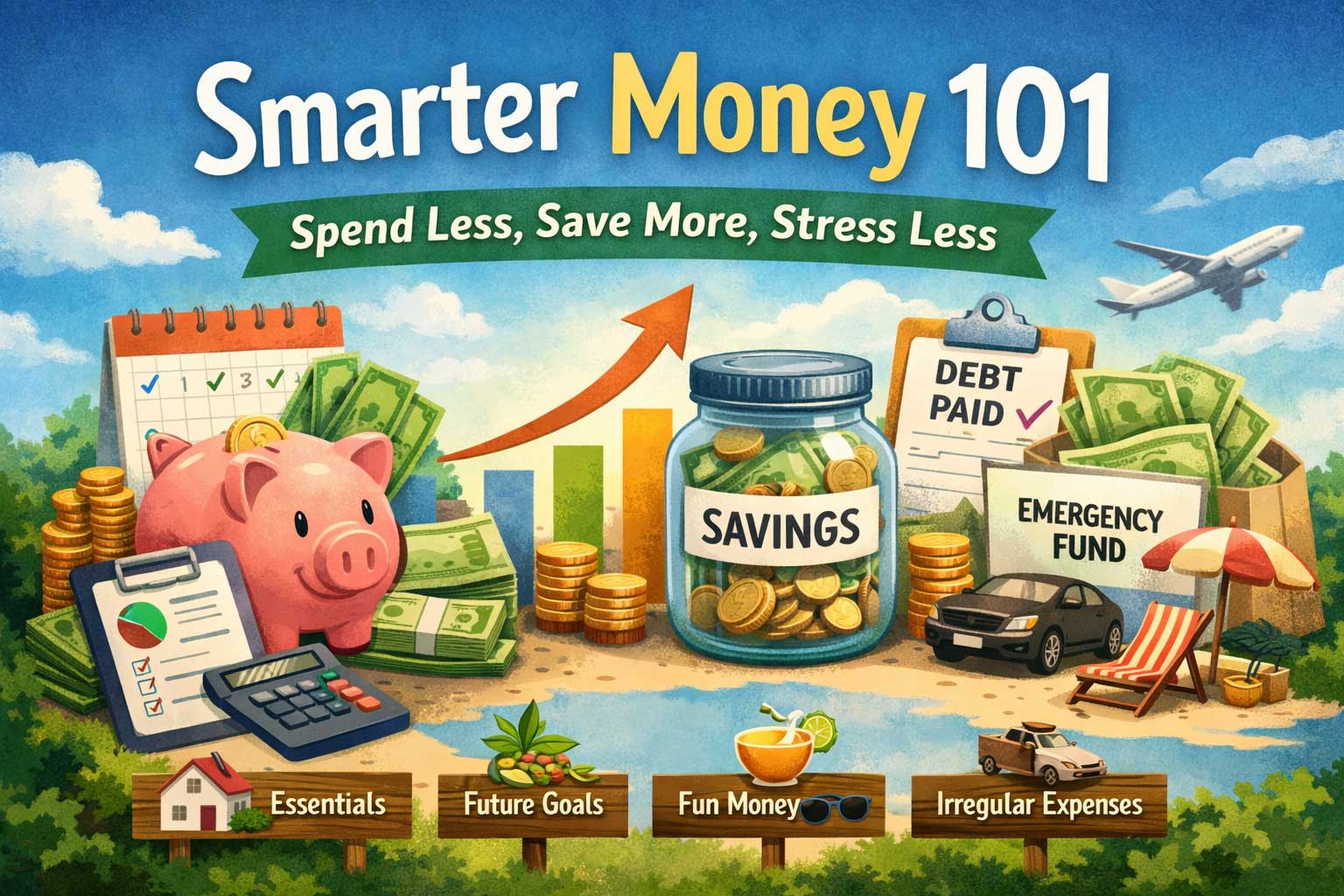
Money stress usually isn’t caused by a lack of intelligence. It’s caused by a lack of clarity. Most people aren’t failing because they “don’t know how to budget.” They’re failing because their financial life is built on a messy pile of small decisions, inconsistent habits, and invisible leaks. They don’t have a system that makes the right choices easier than the wrong ones.
A smarter money system is not about deprivation. It’s about designing your life so your money naturally goes where you actually want it to go. Instead of asking yourself to “have more discipline,” you build a plan that requires less discipline. Instead of tracking every tiny expense forever, you create structure so you can spend guilt-free inside boundaries. Instead of hoping you’ll save “when there’s extra,” you make saving happen automatically and predictably.
This article gives you a complete, simple system you can start immediately. It’s called Smarter Money 101, and it’s designed for real life: irregular expenses, unexpected problems, busy schedules, and the fact that you’re a human being who sometimes buys things for comfort, convenience, and joy.
You’ll learn how to:
- Spend less without feeling punished
- Save more without relying on willpower
- Reduce stress by creating certainty and control
- Build a repeatable system that works even when life is chaotic
- Set up smart defaults so your finances improve while you live your life
Let’s build the system from the ground up.
The Real Goal: Less Stress, More Control, and Guilt-Free Spending
A common mistake is thinking the goal is “spend as little as possible.” That’s not a real life goal. The goal is to spend intentionally, avoid waste, and create financial safety. A great money system doesn’t make you feel trapped. It gives you freedom because you know:
- Your bills are covered
- Your future is being funded
- Your emergencies won’t destroy you
- You can spend on what you value without anxiety
When your money has structure, your brain relaxes. When you stop fearing the unknown, you stop making decisions from panic. A system replaces daily decision fatigue with simple rules.
A good system does three things:
- Protects your essentials (rent, food, utilities, insurance, transportation)
- Funds your future (emergency fund, debt payoff, investing, big goals)
- Allows enjoyment (guilt-free spending that fits your plan)
If any of these are missing, stress goes up. If all three are present, stress goes down.
Why Budgets Fail (And Why Systems Work)
Most budgets fail because they ask too much of you. Typical budgeting advice sounds like this:
- Track everything
- Categorize every purchase
- “Just cut back”
- Be consistent forever
This works for a small percentage of people who enjoy spreadsheets and tracking. But most people are busy, tired, and living in a world designed to make spending effortless. Apps make buying instant. Subscriptions hide costs. Food delivery turns convenience into habit. Advertising never stops. And emotions influence spending more than logic.
A system is different. A system is a structure that runs even when motivation disappears. It’s like brushing your teeth: you don’t need daily inspiration to do it. It’s automatic because it’s built into your routine.
Budgets rely on constant attention. Systems rely on smart design.
Here’s the key shift:
- Budget: “I will try to control everything.”
- System: “I will set up my money so control happens by default.”
This article will teach you how to create that default.
The Smarter Money 101 Framework (The Whole System in One View)
Your system has five parts:
- Clarity Snapshot: Know what’s coming in and what must go out
- Four-Bucket Plan: Give every dollar a job without micromanaging
- Automation Layer: Remove willpower from saving and bills
- Leak-Proofing: Fix the hidden spending drains
- Weekly Rhythm: A 15-minute routine that keeps everything on track
When you combine these, you get a money life that feels calm and predictable.
Now let’s build it step by step.
Part 1: Clarity Snapshot — The 30-Minute Money Reality Check
Before you change anything, you need a simple snapshot. Not a perfect detailed budget. Just a clear reality check.
Step 1: Find your “true monthly income”
If your income is stable (salary), use your average monthly take-home pay. If your income varies, use the average of the last 3–6 months, then subtract a small safety buffer (like 5–10%) to avoid overestimating.
This is not pessimism. It’s stability.
Example:
- Average take-home: 50,000
- Safety buffer: 5% (2,500)
- True monthly income: 47,500
Step 2: List your non-negotiable bills (the “must-pay” list)
Write down all fixed monthly essentials:
- Rent/mortgage
- Utilities
- Phone/internet
- Transportation (public transit, gas, insurance)
- Minimum debt payments
- Basic groceries
- Insurance premiums
This list should be realistic, not idealized. If your grocery spending is usually higher than you wish, use reality, not hope.
Step 3: Identify your “financial pressure points”
Pressure points are categories that cause most stress:
- Debt payments eating cashflow
- No emergency savings
- Irregular expenses (car repairs, medical, gifts)
- High housing costs
- Overspending on food delivery, shopping, or subscriptions
You’re not judging yourself. You’re spotting the areas where the system must do the most work.
Step 4: Check one simple number: your margin
Margin is what’s left after essentials.
Margin = Income − Essentials
If margin is:
- Healthy: You can build savings and enjoy life
- Small: You need tighter structure and leak-proofing
- Negative: You need urgent adjustments: cut costs, increase income, or reduce debt burden
Margin is your breathing room. The entire goal of Smarter Money 101 is to increase margin over time.
Part 2: The Four-Bucket Plan — Simple, Flexible, and Powerful
Instead of tracking 25 categories, use four buckets. This is the core of the system.
Bucket 1: Essentials (Keep Life Running)
This includes the must-pay basics: housing, utilities, basic food, transport, insurance, minimum debt payments.
Target range (general guideline):
- 50–70% of income depending on your situation
If essentials are above 70%, you may need to adjust housing, transport, debt, or income.
Bucket 2: Future You (Savings, Investing, Debt Payoff)
This is the bucket that creates safety and growth. It includes:
- Emergency fund contributions
- Extra debt payments
- Retirement contributions
- Investing
- Sinking funds for planned expenses
Target range:
- 15–30% depending on goals and debt
Bucket 3: Fun & Flexible (Guilt-Free Spending)
This includes:
- Dining out
- Shopping
- Entertainment
- Hobbies
- Travel
- Convenience spending
Target range:
- 10–20% depending on priorities
Bucket 4: Irregulars (The “Life Happens” Costs)
This is where most budgets collapse because people forget it exists. Irregular expenses are predictable over a year but not monthly.
Examples:
- Car maintenance
- Medical expenses
- Gifts and holidays
- School costs
- Home repairs
- Annual subscriptions
- Travel fund
- Clothing replacement
Target range:
- 5–15% depending on your life
This bucket turns chaos into calm. When irregular expenses show up, they don’t feel like emergencies.
How to Choose Your Bucket Percentages (Without Overthinking)
Start with a simple baseline. Here are three templates:
Template A: Starter Stability (if you feel stressed and unsteady)
- Essentials: 65%
- Future You: 15%
- Fun & Flexible: 10%
- Irregulars: 10%
Template B: Balanced Growth (if you’re stable and want progress)
- Essentials: 60%
- Future You: 20%
- Fun & Flexible: 10%
- Irregulars: 10%
Template C: Aggressive Freedom (if you want fast savings or debt payoff)
- Essentials: 55%
- Future You: 30%
- Fun & Flexible: 5–10%
- Irregulars: 10%
Pick one. You can adjust later. The magic is not perfect percentages; it’s consistency.
Part 3: Automation Layer — Make Good Decisions Automatic
Automation is where the system becomes effortless. If your savings depends on you remembering, it will fail eventually. If your bills depend on timing and willpower, late fees and stress will happen.
Automation turns your plan into reality.
Automation Step 1: Build a “money map” of accounts
A simple structure:
- Income account (where money lands)
- Bills account (for essentials)
- Savings/Future account (emergency + goals)
- Spending account (fun & flexible)
You can do this with separate bank accounts or with one account plus separate “spaces” if your bank supports it. The goal is separation. Separation reduces confusion and overspending.
Automation Step 2: Schedule transfers right after payday
Your paycheck is your strongest moment. That’s when money is available and intentions are high. So you transfer immediately:
- A set amount to Bills
- A set amount to Future You
- A set amount to Irregulars (sinking funds)
- What remains is Fun & Flexible
This means you never have to guess what you can spend. You already moved the money where it needs to go.
Automation Step 3: Automate bills wherever possible
Set bills to autopay from your Bills account. Then your Bills account is always “ready.” When a bill hits, it’s paid. No mental load.
Automation Step 4: Create “sinking funds” for irregulars
Sinking funds are planned savings buckets. Instead of being surprised by a yearly cost, you save monthly.
Examples:
- Car maintenance: total yearly estimate ÷ 12
- Gifts/holidays: total estimate ÷ 12
- Medical: average annual out-of-pocket ÷ 12
- Annual subscriptions: total yearly estimate ÷ 12
Even if your estimates are imperfect, you’ll be far better prepared than before.
Part 4: Spend Less Without Feeling Miserable (The Smart Spending System)
Spending less does not mean living a smaller life. It means stopping waste and buying with intention.
Here are the core principles:
Principle 1: Cut what you don’t care about, protect what you love
Most people cut randomly: “No coffee, no fun, no joy.” That’s why they quit.
Instead, identify:
- 2–3 spending areas you truly value
- 2–3 spending areas you don’t value but leak money
Then cut the leaks hard and keep your values funded.
Examples of common leaks:
- Subscriptions you forgot
- Delivery fees and convenience spending
- Impulse shopping
- Overpriced banking fees
- Eating out because there’s no meal plan
- “Small” purchases that happen daily
Principle 2: Reduce decision points
The more often you decide, the more likely you break. Build defaults:
- Same grocery list template
- Same meal rotation
- Same weekly spending limit
- Same transfer schedule
This reduces mental fatigue and prevents “oops” spending.
Principle 3: Use “friction” to stop impulse spending
Make impulse buying harder:
- Remove saved cards from shopping apps
- Turn off one-click buying
- Unsubscribe from promo emails
- Log out of shopping apps
- Wait 24 hours for non-essential purchases
- Put a spending rule: “If it’s not on my list, it waits.”
Friction doesn’t remove your freedom. It protects your priorities.
The 10 Biggest Ways to Spend Less (Without Tracking Every Penny)
You don’t need to track everything. You need to focus on high-impact moves.
1) Cancel and renegotiate recurring costs
Subscriptions are silent budget killers. Once per month, do a subscription audit:
- Cancel what you don’t use
- Downgrade what you barely use
- Consolidate duplicates
Then renegotiate:
- Phone plans
- Internet
- Insurance
- Banking fees
Even small monthly reductions become big annual savings.
2) Create a “default weekly food plan”
Food is a major spending category that blends essentials and convenience. A simple plan beats a complicated one.
Try this:
- Choose 2 breakfasts you repeat
- Choose 3 lunches you repeat
- Choose 3 dinners you rotate
- Plan 1 “fun meal”
- Keep emergency quick food at home
This reduces takeout spending because you removed the “What should we eat?” problem.
3) Build a convenience budget (so you stop pretending)
Many people overspend on convenience because they don’t plan for it. Create a small convenience allowance inside Fun & Flexible. When it runs out, convenience stops. This turns convenience into a conscious choice, not an automatic habit.
4) Use “one in, one out” for shopping categories
If you buy one clothing item, one old item leaves. Same with gadgets, decor, and hobby items. This slows accumulation and reduces impulse buying.
5) Set a “spending speed limit”
A spending speed limit is a weekly cap for Fun & Flexible. Not a daily restriction.
Example:
- You allocate 8,000 monthly for Fun & Flexible
- Your weekly speed limit is 2,000
If you spend 2,000 by Wednesday, you stop until next week or you borrow from next week.
This creates awareness without constant tracking.
6) Replace “treat spending” with “planned joy”
Treat spending is emotional and impulsive. Planned joy is intentional.
Instead of random purchases, create:
- A small weekly joy allowance
- A monthly experience budget
- A list of free/low-cost activities
The goal is to meet emotional needs without financial damage.
7) Upgrade your “pause muscle”
Before spending, ask:
- What problem am I solving?
- Is this the cheapest way to solve it?
- Will I still want this next week?
- Is this worth delaying a bigger goal?
You don’t need to say no. You need to decide consciously.
8) Switch from “cheap” to “cost-effective”
Cheap can be expensive if it breaks quickly. Cost-effective means:
- It lasts
- You use it
- It improves your life
- It prevents repeat purchases
Buy less, buy better—when it aligns with your values.
9) Use “cash-like” spending for problem categories
If you overspend in one area (like dining out), use a dedicated card or account just for that. When it’s empty, it’s empty. This is a powerful behavior tool.
10) Set rules for big expenses
Examples:
- Any purchase over a set amount requires a 48-hour wait
- Any new subscription must replace an old one
- Any major purchase must be planned in Irregulars or a goal fund
Rules reduce regret.
Part 5: Save More Without Feeling Like You’re Losing
Saving more feels painful when it feels like deprivation. The trick is to make saving feel like paying yourself first, not taking from your life.
Step 1: Start with a “minimum effective savings rate”
If saving feels hard, start smaller and scale.
Examples:
- 1% of income
- A fixed amount per paycheck
- Round-up savings
- Automatic transfer of a small number
Consistency matters more than size at the beginning.
Step 2: Build the first emergency buffer (the stress killer)
The first goal is not a huge emergency fund. It’s a buffer that stops panic.
Start with:
- A mini buffer: enough to cover a few essential expenses
Then grow it gradually.
A buffer prevents “emergency debt,” which is one of the biggest sources of money stress.
Step 3: Use the “ladder” approach to savings goals
A savings ladder means you build savings in stages:
- Mini buffer
- One month of essentials
- Three months of essentials
- Longer-term security
Each step reduces stress and increases confidence.
Step 4: Treat irregular savings like bills
If you know you’ll spend on gifts, travel, repairs, or annual fees, save monthly. This prevents the cycle of “I was doing fine until…”
Step 5: Increase savings through lifestyle design, not punishment
Savings grows when your baseline costs become smarter:
- Better meal planning
- Lower recurring bills
- Less impulse buying
- More intentional spending
- Stable routines
As your system improves, your savings rate naturally increases.
The Debt Stress Solution (If Debt Is Part of Your Story)
Debt is not just math; it’s stress. It’s the feeling that your past decisions control your future.
A smarter money system deals with debt in a calm, structured way.
Step 1: Keep essentials stable first
If you try to crush debt while your essentials are unstable, you’ll relapse. Pay essentials, build a small buffer, then increase debt payments.
Step 2: Choose a payoff strategy you can maintain
Two common strategies:
- Snowball method: pay smallest debt first to build momentum
- Avalanche method: pay highest interest first to save money
Both work. The best method is the one you will stick with.
Step 3: Use “automatic extra payments”
If you can pay extra, automate it. The less you think about it, the more consistent you’ll be.
Step 4: Stop new debt from entering the system
Debt payoff fails when new debt replaces old debt. Create rules:
- No new debt for lifestyle spending
- Use the spending speed limit
- Build an emergency fund to handle surprises
Step 5: Celebrate progress in ways that don’t sabotage you
As debt drops, you need small rewards that don’t create new stress. This might be:
- A planned low-cost treat
- A free experience
- A small budgeted purchase from Fun & Flexible
Reward progress without undoing it.
The Weekly Rhythm: A 15-Minute Routine That Makes Everything Work
The biggest secret is that money stress doesn’t come from money itself—it comes from uncertainty. A short weekly routine creates certainty.
Pick one day each week. Set a timer for 15 minutes.
The 15-minute Smarter Money Check-In
- Check account balances (Bills, Spending, Savings)
- Review upcoming bills (next 7–14 days)
- Check your spending speed limit (are you on track?)
- Move small money if needed (adjust between buckets)
- Plan one money win for the week (cancel a subscription, meal plan, sell an item, negotiate a bill)
That’s it.
This routine prevents financial surprises. Surprises are stress.
The Smarter Money Rules (Simple, Memorable, Life-Proof)
Rules make systems easier. Here are your core rules:
- Pay essentials first, always.
- Save automatically, even if small.
- Irregulars are real—fund them monthly.
- Fun is allowed, but it must fit the plan.
- Big purchases wait at least 24–48 hours.
- New subscriptions must replace old ones.
- Weekly check-in prevents monthly chaos.
Rules reduce the need for constant decisions.
How to Build Your System in 7 Days (Step-by-Step)
Here’s a simple one-week setup plan.
Day 1: Clarity Snapshot
- Income
- Essentials
- Margin
- Pressure points
Day 2: Four Buckets
- Choose your template percentages
- Decide your bucket amounts for the month
Day 3: Account Structure
- Set up separate accounts or “spaces”
- Decide where bills, spending, and savings will live
Day 4: Automate Transfers
- Transfer to savings/goals right after payday
- Transfer to bills
- Transfer to irregulars
Day 5: Autopay Bills
- Set autopay for major bills
- Set reminders for non-autopay bills
Day 6: Leak-Proofing Audit
- Cancel unused subscriptions
- Remove shopping app friction
- Set spending rules
- Create food plan baseline
Day 7: Weekly Routine
- Choose a weekly check-in time
- Set a repeating reminder (in your phone)
- Do your first check-in and adjust
After this week, you’re not “starting a budget.” You’re running a system.
Common Problems (And How to Fix Them Without Quitting)
“I tried before and failed.”
That means your system asked too much from you. Start smaller:
- Smaller savings amount
- Fewer categories
- More automation
- Stronger irregulars funding
- Weekly check-in to keep it real
“My income changes month to month.”
Use:
- Conservative average income
- Bigger irregulars bucket
- Weekly check-in for adjustments
- A buffer in bills account
“My partner spends differently than I do.”
Use shared rules, not shared micromanagement:
- Agree on Essentials and Future You first
- Give each person a personal Fun & Flexible allowance
- Keep spending autonomy inside boundaries
This reduces conflict.
“I keep overspending in one category.”
Don’t shame yourself. Is it:
- Emotional spending?
- Convenience spending?
- Social spending?
- Boredom spending?
Then solve the root:
- Add friction
- Create a planned alternative
- Reduce triggers
- Create a “cool-off” rule
“Unexpected expenses keep wrecking me.”
That means your Irregulars bucket is too small or not defined. Expand it and create sinking funds. Most “unexpected” expenses are actually expected over a year.
Money Stress Is Often Emotional (So Your System Must Respect That)
A smarter money system works because it respects psychology:
- You need autonomy (not constant restrictions)
- You need wins (progress you can see)
- You need safety (buffers and sinking funds)
- You need simplicity (few decisions, clear rules)
If your plan ignores emotions, it won’t last.
So build it with compassion. You’re not trying to become a robot. You’re trying to create a life that feels stable.
The Long-Term Payoff: What This System Gives You Over Time
At first, the benefits are emotional:
- Less anxiety
- Fewer surprises
- More confidence
Then the benefits become financial:
- Growing savings
- Lower debt
- More margin
- Better opportunities
Then the benefits become life-level:
- More freedom to choose jobs
- More ability to handle emergencies
- More control over your future
- Less conflict in relationships
- More generosity and joy
A good system turns money into a tool, not a threat.
Smarter Money 101 in Practice: A Simple Example Month
Let’s say your monthly take-home is 40,000.
You choose a Balanced Growth plan:
- Essentials: 60% = 24,000
- Future You: 20% = 8,000
- Fun & Flexible: 10% = 4,000
- Irregulars: 10% = 4,000
Now your automation:
- Transfer 24,000 to Bills account
- Transfer 8,000 to Savings/Debt/Investing
- Transfer 4,000 to Irregulars sinking funds
- Leave 4,000 in Spending account
Now your life:
- Bills get paid on time
- Savings grows automatically
- Irregular expenses stop feeling like emergencies
- Spending money is guilt-free because it’s planned
You still make choices. But you’re not constantly guessing.
The System Upgrade Path: How to Level Up After Month One
After 30 days, you’ll notice what works and what doesn’t. Then you upgrade.
Upgrade 1: Increase the Irregulars accuracy
Track irregular expenses for one month and adjust sinking funds.
Upgrade 2: Increase savings by 1–2%
Small increases are powerful.
Upgrade 3: Reduce a major recurring bill
Negotiate, downgrade, or switch providers.
Upgrade 4: Build a stronger buffer
Grow emergency savings to reduce stress further.
Upgrade 5: Add goal-specific savings
Vacation, down payment, education, business, or any meaningful goal.
This keeps your system evolving without becoming complicated.
Final Reset: If You Only Remember One Thing
Spending less and saving more is not about becoming “better at self-control.” It’s about building a system that makes self-control less necessary.
When you have:
- Clear buckets
- Automated transfers
- Irregulars funded
- A weekly check-in
- Simple rules
…your finances improve without constant struggle.
You don’t need perfection. You need a repeatable structure you can live with.
Start small. Automate what matters. Protect essentials. Fund future you. Allow fun without guilt. And do the weekly check-in that keeps everything calm.
That’s Smarter Money 101: a simple system to spend less, save more, and stress less.